
How to customize secret agent mission cards and party badges
A secret-agent printable should make a party easier to run, not ask children for real secrets. Use fictional codes, simple role badges and mission cards that an adult can understand at a glance.
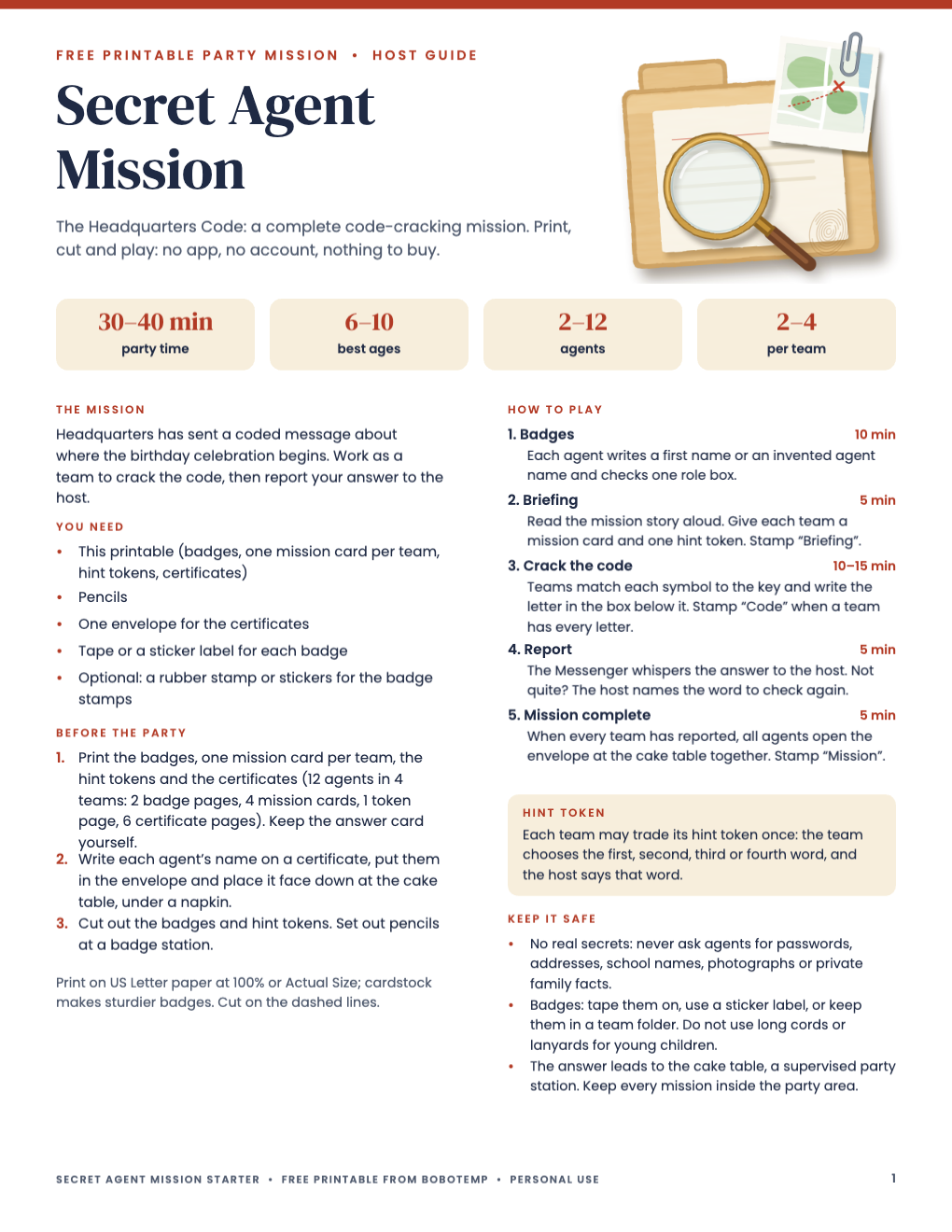
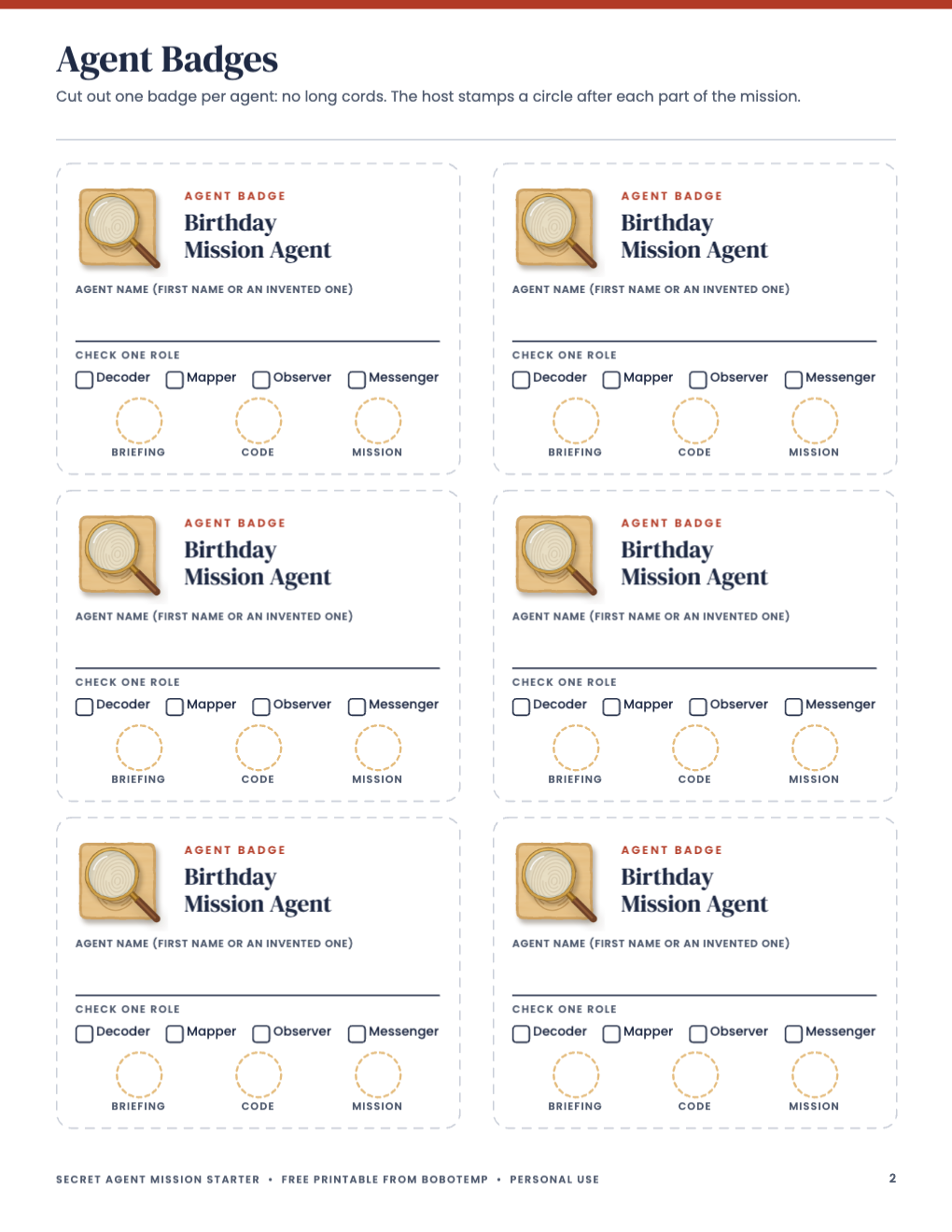
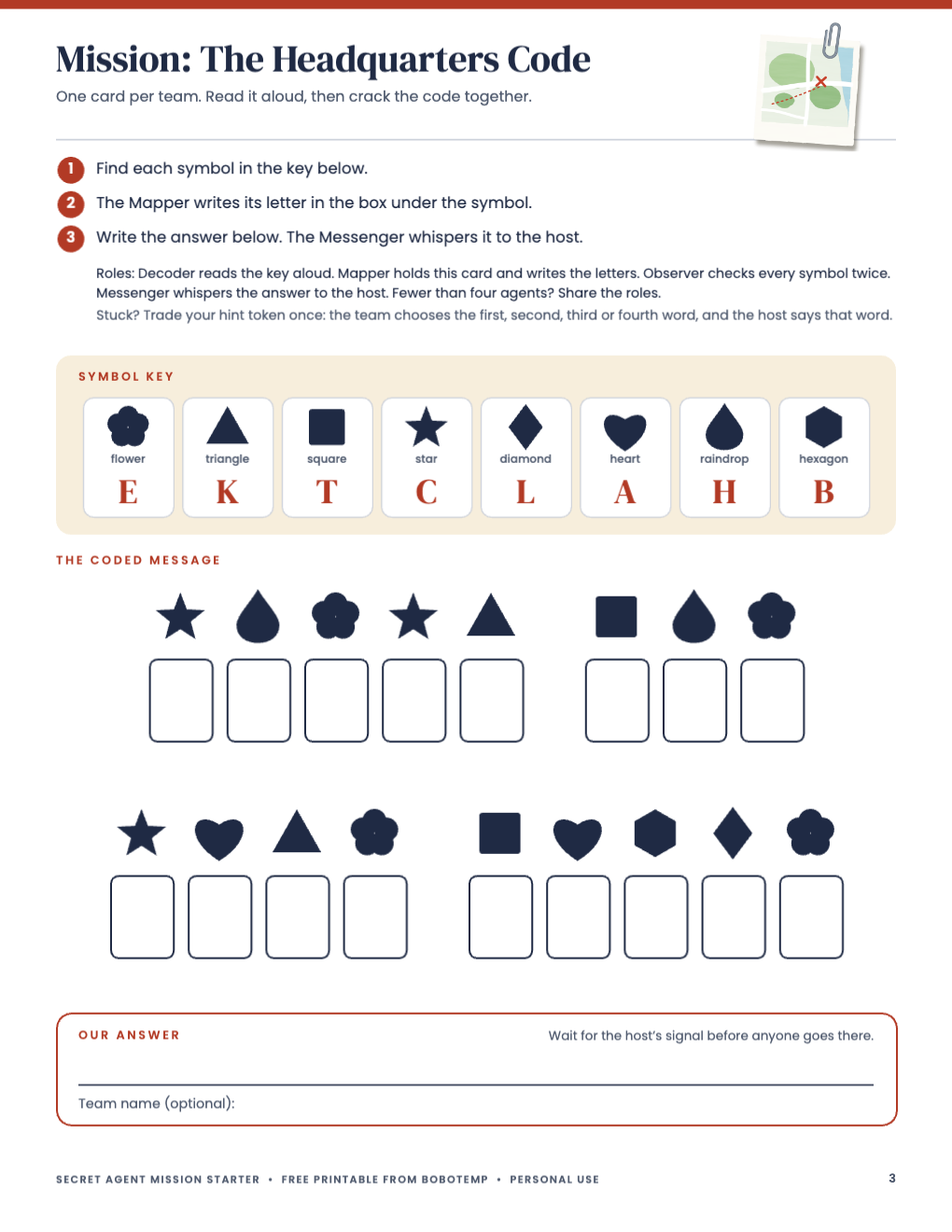
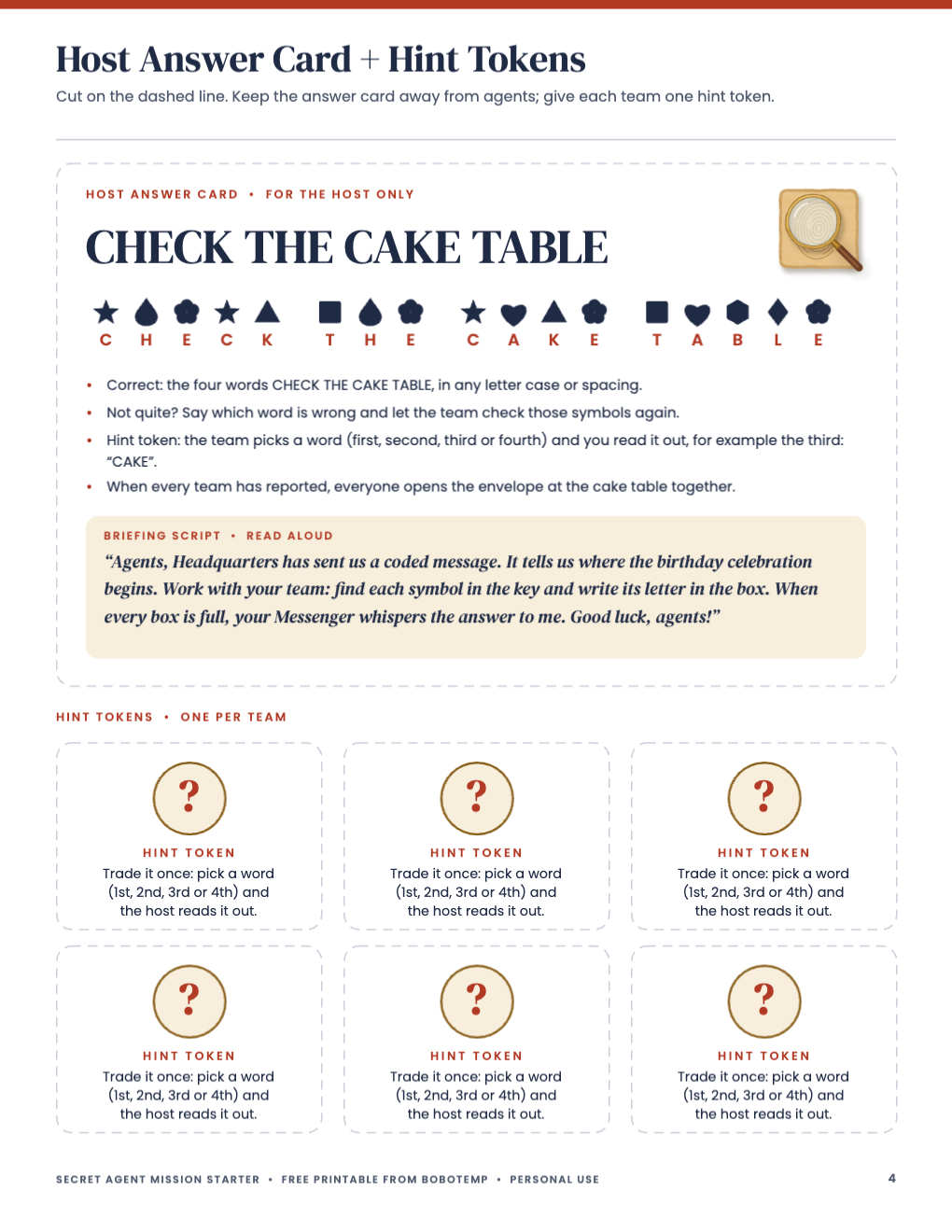
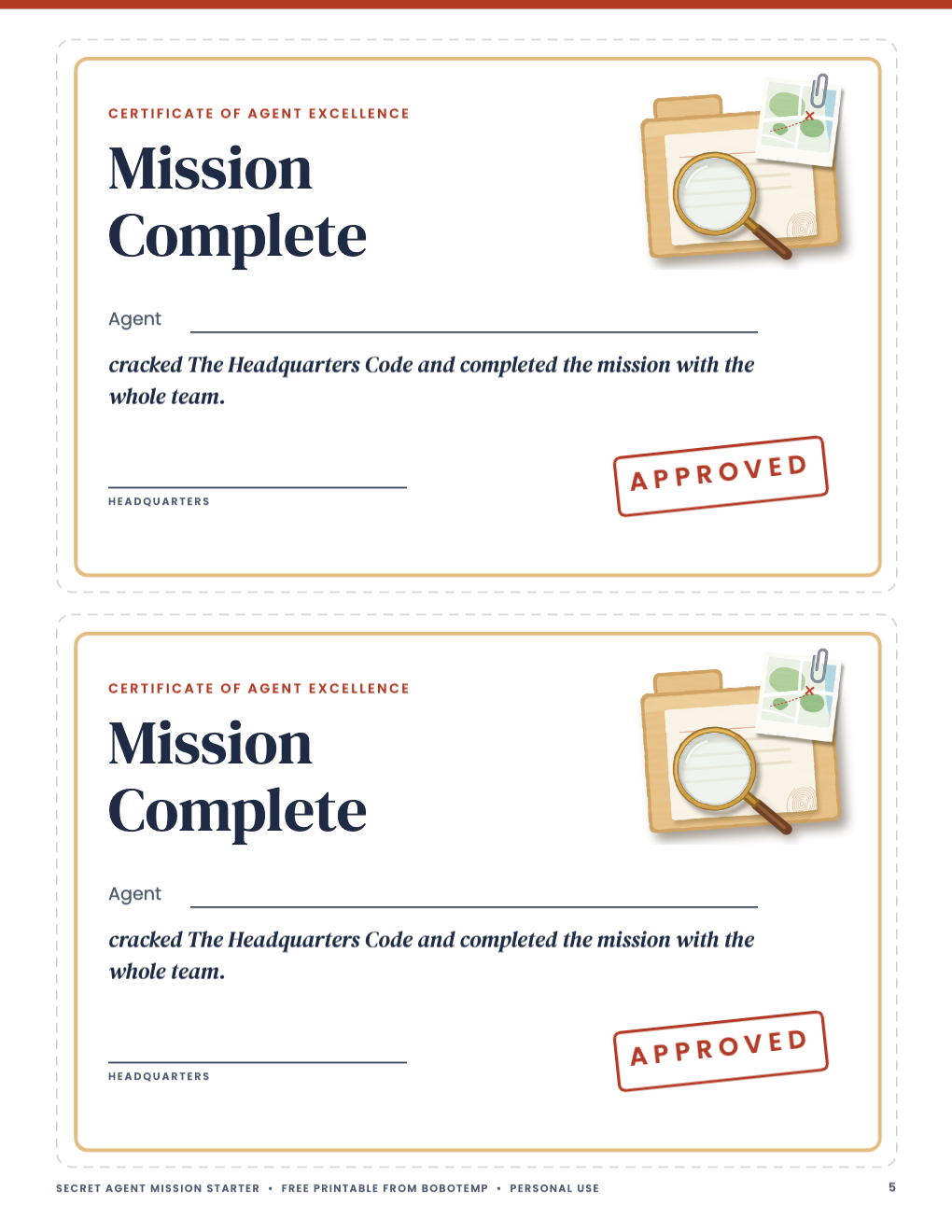
Free starter: SA-FREE-01 is a separate five-page starter with a host guide, six badges, a 17-letter code mission, a hint-and-answer card and completion certificates. Its official editable package is signed for BoboCreate Desktop 0.3.19 or later. The SA-01 invitation master remains private.
Both downloads are the free edition. Importing it uses one of BoboCreate Free’s three design places. In Desktop 0.3.19 or later, its three verified official images do not use personal-image places; images added by the user still count normally.
Separate invitation fields from game fields
An invitation needs the birthday child’s name, date, time, venue and RSVP details. A mission card needs an objective, boundary, supplies and finish condition. Do not reuse the invitation page as an activity card simply because the artwork matches; private contact details should not circulate around game stations.
| Invitation | Date, start and end time, location, RSVP and clothing note. |
|---|---|
| Badge | First name or invented agent name, role and mission stamps. |
| Mission card | Objective, safe play area, supplies, time and success condition. |
| Host sheet | Setup, answer key, adaptations and cleanup. |
Choose readable secret-agent typography
Use decorative display type for one short heading. Put instructions in a plain face with open letter shapes. All-caps can work for “MISSION 1” but becomes tiring in a four-line clue. A pale gray “classified” texture belongs behind the edges, not behind the answer.
Print one clue at the size children will hold it. If an adult needs to zoom the PDF to read the key, the card is not ready. Keep high contrast and pair colors with shapes so the code does not exclude guests who distinguish colors differently.
Create badges without collecting personal data
- Add an editable first-name or fictional agent-name field.
- Add role choices such as Decoder, Mapper, Observer and Messenger.
- Leave three large stamp spaces for mission progress.
- Remove fields for age, school, online handle, address and photograph.
- Duplicate the badge only inside the print layout needed for the confirmed guest count.
Do not print badges on lanyards with long cords for young children. A peel-off label, clip used under adult supervision or card kept in a team folder is safer for an active game.
Write clues with one verifiable answer
A symbol code should use only the letters in its short answer. An observation card should name exactly how many differences to find. A route clue should lead to a supervised party station, not a private cupboard or outside gate. Put the answer and reset instruction on the host sheet.
- Test every clue with someone who did not write it.
- Give teams one hint token so asking for help is part of the rules.
- Use pictures and read-aloud instructions for newer readers.
- Avoid pretend bombs, threats, real weapons and frightening capture stories.
- Never ask children to obtain a real password or private fact.
Keep nested groups editable
When a badge or card is grouped, check which objects a user is meant to change. Lock background art and decorative rules, but keep names, roles, objectives and times selectable. After editing one value, export and reopen a test copy to confirm the text survived and the group did not flatten into an image.
If the text box contains a custom font, preserve the registered font metadata. Do not replace it by pasting styled text from another application. A missing font can change line length and push a clue beyond its panel even when the words are correct.
Prepare a real print set
Export the finished pages as PDF. Use Actual Size or 100% and cut one complete badge sheet before printing the batch. Put mission cards in station order, confirm the answer key matches the final wording and count small pieces after the game.
The free set has its own design identity, committed checksums, preview images and verified official-template signature. The private SA-01 source must never be substituted for this free package.